The cortado coffee associated with Spain, and its name comes from the Spanish word cortar, meaning “to cut” — a fitting description for what milk does to the concentrated character of espresso. In different coffee cultures, the drink has taken on slightly different forms and names, including Gibraltar in parts of the American specialty-coffee scene. What has remained consistent is the idea of restraint: it is smaller than a latte, less foam-driven than a cappuccino, and intended to keep the taste of coffee clearly present.
That sounds simple until the drink tastes either too sharp or too milky. The interesting part is understanding what actually creates that middle ground.
The balance starts with a conversation, not a formula
A cortado works through the contrast between espresso and milk. Espresso brings intensity, acidity, bitterness and its own flavour notes, while milk adds sweetness, softness and body. The goal is not to make coffee taste weaker, but to change how its intensity feels. Milk can round sharp acidity, soften bitterness and deepen natural sweetness. That is why the same cortado can taste completely different with another coffee.
Why the milk changes more than intensity
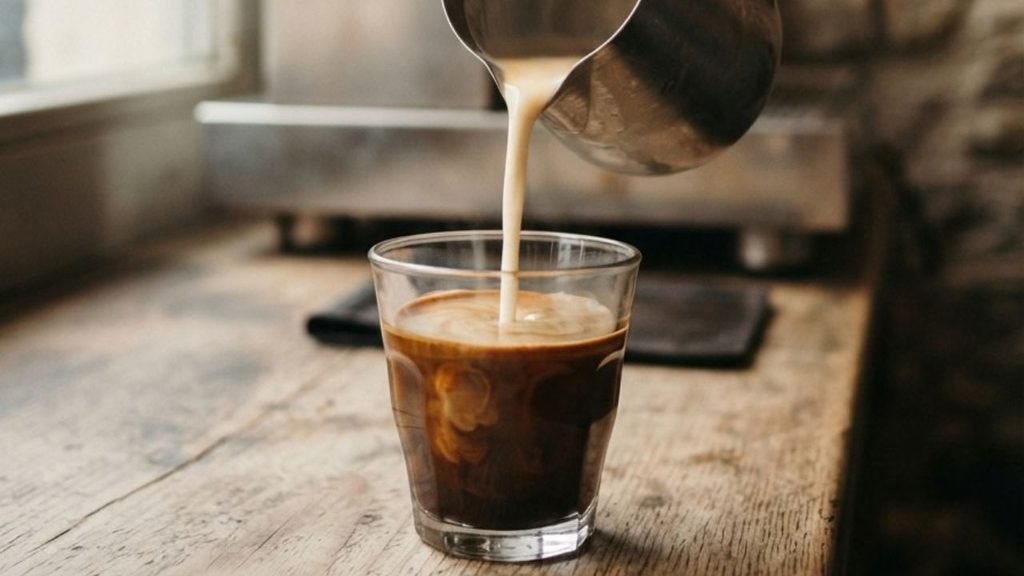
Milk does something more interesting than simply reducing the strength of coffee. Its sweetness can make certain flavours in espresso seem more pronounced. Its fat content affects the way flavour compounds are perceived, while its texture changes the physical sensation of the drink in the mouth.
That combination is important. Imagine tasting a concentrated espresso and then tasting the same coffee with a modest amount of milk. The second version may seem less acidic, less bitter and softer, but it can also reveal flavours that were difficult to notice at full concentration.
This is one reason a cortado can feel surprisingly expressive despite being such a small drink.
The milk creates space around the espresso without completely moving it out of the foreground.
The small size is doing real work
The cortado’s modest size is not merely a café tradition or an aesthetic choice. Volume affects balance. Add considerably more milk and the relationship changes. The coffee becomes quieter, the milk becomes more prominent, and the drink begins moving toward the territory of a latte or flat white. Remove too much milk and the espresso becomes dominant again. The small format keeps the two close together.
This also explains why the cortado can be more revealing than a much larger milk-based coffee. There is less room for an uneven espresso to hide. If the coffee is overly bitter, excessively sour or lacking sweetness, the milk may soften the edges but cannot completely disguise the problem.
The 1:1 idea is useful, but coffee culture is messier
Many modern descriptions of a cortado point toward an approximately equal relationship between espresso and milk. That proportion is useful because it communicates the drink’s basic philosophy: coffee and milk should have comparable influence. The drink does not have one perfectly standardised identity across every café and country. Spanish versions can differ from interpretations found in specialty coffee shops elsewhere. Gibraltar, for example, developed its own identity around a small glass and a restrained espresso-and-milk combination. This variation is not necessarily a problem.
What separates a cortado from its close relatives
Cortado, flat white, latte and cappuccino are frequently placed beside one another, and there is good reason for the confusion. All belong to the broad family of espresso-and-milk drinks. Their differences become clearer when you stop looking at the names and look at proportion and texture. A latte gives milk considerably more room. Its larger volume produces a softer, more milk-forward experience.
A cappuccino places greater emphasis on aerated milk and foam, creating a noticeably different texture. A flat white generally sits closer to the espresso, with a more concentrated character and fine microfoam, although definitions vary between coffee cultures.
The details that quietly change the taste
The balance of a cortado can shift because of details that are easy to overlook.

Espresso character
Not every coffee behaves the same way with milk. A naturally sweet espresso with chocolate or caramel notes can become round and rich. A bright, fruit-forward espresso may retain more acidity and produce a livelier contrast with milk. A darker roast may lean toward bitterness and roasted flavours. Thinking about coffee through characteristics such as flavour, aroma and mouthfeel can help explain why the same milk treatment produces different results from one coffee to another.
There is no universally “correct” coffee for a cortado. The more useful question is whether the coffee’s character remains interesting after milk enters the picture.
Milk texture
The milk should support the coffee rather than becoming a thick, separate layer of foam. Too much air can make the drink feel closer to a cappuccino. Very flat milk can make it feel thinner than intended. The sweet spot is a smooth texture that adds body without becoming the main attraction.
This is a subtle difference, but it is one you can feel before you consciously identify it.
Temperature
Heat also changes perception. Warm milk can bring out a gentle sweetness, while excessive heat can make the experience feel flatter and less delicate. Temperature affects aroma and mouthfeel as much as comfort.
A cortado is therefore sensitive to things that do not appear on its short ingredient list.
How to recognise a genuinely balanced cup
The easiest way to judge a cortado is not by asking whether it tastes “strong” enough.
Look for a relationship.
- Coffee should remain identifiable. If the drink tastes almost entirely of warm milk, the balance has shifted.
- Milk should soften rather than erase. You should notice greater roundness without losing the espresso’s character.
- Acidity should have a role. Brightness is not automatically a flaw; harsh, disconnected sourness is a different matter.
- Bitterness should stay controlled. Some bitterness belongs to coffee, but it should not dominate every other sensation.
- Texture should support flavour. The drink should feel smooth and integrated rather than dominated by a thick foam layer.
- The finish should still resemble coffee. A balanced cortado leaves the espresso present after the milk has done its work.
These cues are more useful than memorising a single supposedly perfect proportion.
The misconception that makes cortado harder to understand
The biggest misunderstanding is that balance means making espresso taste weaker. It doesn’t. A well-balanced cortado can still taste distinctly intense. The difference is that the intensity feels controlled. Milk rounds the edges, adds sweetness and changes the texture, but the coffee retains its identity.
This is an important distinction because modern coffee culture often treats “smooth” as automatically better.

things worth remembering
1. The two ingredients have different jobs
Espresso provides concentration and flavour complexity; milk contributes sweetness, softness and body.
2. Equal parts are a reference, not a universal rule
The cortado has different interpretations, so the relationship matters more than obsessing over one exact measurement.
3. Milk does not automatically improve bad espresso
It can soften unpleasant flavours, but it cannot transform fundamentally poor coffee into excellent coffee.
4. More milk changes the identity of the drink
Once milk becomes the dominant element, you are moving toward a different style of coffee rather than simply making a “creamier” cortado.
5. Texture matters as much as flavour
A cortado should feel integrated. Excessive foam can change its character even when the coffee-to-milk relationship appears similar.
FAQ’s
1. Why is a cortado called a cortado?
The name comes from the Spanish cortar, meaning “to cut.” It refers to milk cutting or softening the intensity of espresso.
2. Is a cortado always equal parts coffee and milk?
No. An approximately equal ratio is common in modern café interpretations, but cortado proportions vary by region, café and coffee tradition.
3. Does a cortado taste stronger than a latte?
Usually, yes. Because there is less milk relative to the espresso, the coffee tends to remain more prominent.
4. Is a cortado supposed to be foamy?
Not heavily. Its texture is generally smoother and less foam-focused than a cappuccino.
5. Why can the same cortado taste different from one café to another?
The coffee itself, espresso extraction, milk, temperature, texture and proportions can all change the final flavour.
The appeal of keeping things this small
There is something unusually revealing about a drink with so little room to hide. The cortado does not depend on syrups, elaborate toppings or a large volume to create interest. Its character comes from proportion and interaction. Espresso remains recognisable, while milk changes its edges, texture and perceived sweetness.
That makes the cortado more than a smaller milk coffee. It is a reminder that restraint can make details louder.