Caesar salad is easy to recognize from its crisp romaine, Parmesan, golden croutons and creamy dressing. It is linked to Caesar Cardini, who served it in Tijuana in the 1920s. Since then, the salad has evolved in many ways, but getting the dressing right can still be surprisingly tricky.
Getting Caesar dressing right can be tricky when it turns too salty, sharp, heavy or bland. This guide shows how to bring those flavors into balance without overcomplicating the dressing.
Timing at a glance
| Prep Time | Total Time | Servings |
| 10 minutes | 10 minutes | 4 servings |
These times are only a guide. Your actual prep or cooking time can be shorter or longer depending on how quickly you work, how finely you prepare the ingredients and how much time you take to taste and adjust the dressing.

What goes into a well-balanced Caesar
- 1 egg yolk
- 1 small garlic clove, finely grated
- 2 anchovy fillets, finely mashed
- 1½ tablespoons fresh lemon juice
- 1 teaspoon Worcestershire sauce
- ½ teaspoon Dijon mustard
- ⅓ cup neutral oil or mild olive oil
- ¼ cup finely grated Parmesan
- ¼ teaspoon freshly ground black pepper
- A small pinch of salt, only if needed
The important thing here is not simply having all the ingredients. Several of them perform similar jobs. Anchovies, Parmesan and Worcestershire sauce all add savory depth, while Parmesan and anchovies also bring salt. That is why it is better to taste before adding extra salt.
When one ingredient is missing
You do not need to abandon the dressing because one ingredient is missing. Some substitutions work better than others, though, and each changes the character slightly.
| Ingredient | Possible replacement | What to expect |
| Anchovies | 1 teaspoon extra Worcestershire sauce | Less deep and savory |
| Egg yolk | 2 tablespoons mayonnaise | Creamier and easier to emulsify |
| Dijon mustard | ½ teaspoon prepared mustard | Slightly sharper flavor |
| Worcestershire sauce | A little extra lemon juice with a pinch of salt | Brighter, but less complex |
| Parmesan | Pecorino Romano | Stronger and noticeably saltier |
If you replace Parmesan with Pecorino Romano, hold back on the salt until the very end. The cheese may already provide enough.
The dressing comes together in stages
1. Start with the flavors that give it character
Place the egg yolk, grated garlic, mashed anchovies, lemon juice, Worcestershire sauce and Dijon mustard in a bowl. Whisk until the mixture looks even and the anchovies have mostly disappeared into the base.
This is where the foundation of the dressing is established. The garlic should be noticeable but not aggressive, while the anchovy should contribute savoriness without making the dressing taste obviously fishy.
2. Add the oil with a little patience
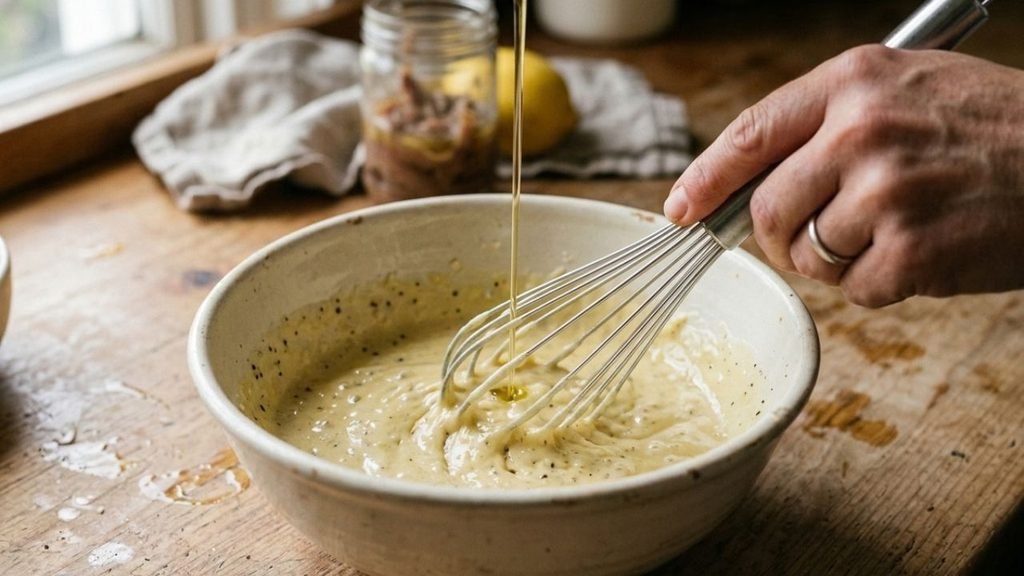
While whisking continuously, slowly pour in the oil. A thin stream works better than adding it all at once. As the oil combines with the yolk and other ingredients, the mixture caesar salad dressing become thicker and smoother. This is the emulsion forming, which is what gives Caesar dressing its characteristic creamy texture. Egg yolk contains emulsifying compounds that help oil and water-based ingredients stay dispersed rather than separating.
There is no need to whisk violently. Consistency matters more than speed.
3. Add the Parmesan at the end
Once the dressing has thickened, stir in the finely grated Parmesan and black pepper. Taste it before adding salt. At this stage, the dressing should taste rich but still bright. If it feels heavy or slightly dull, add a few drops of lemon juice. If it is too sharp, a little more oil or Parmesan can soften the edges.
Make one adjustment at a time. Otherwise, it becomes difficult to tell which change actually improved the dressing.
4. Test it on romaine, not just from the spoon
This small step makes a surprisingly large difference.
Dip a crisp romaine leaf into the finished dressing and taste them together. The dressing needs enough flavor to survive contact with the lettuce without completely covering its freshness.
A dressing that tastes slightly intense on its own may be exactly right once it coats several leaves. Croutons and extra Parmesan will also add salt and richness, so the finished salad needs to be considered as a whole.
Give the salad some contrast
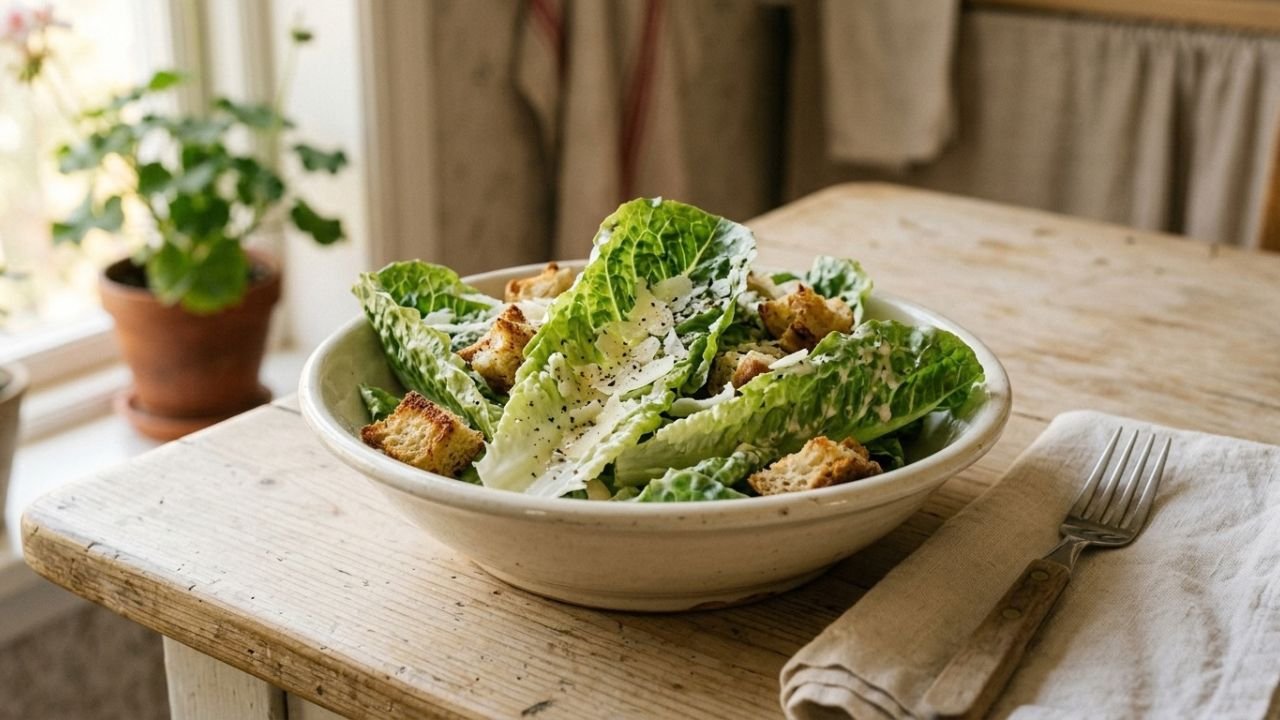
Once the dressing is ready, toss it with crisp romaine shortly before serving. Add freshly grated Parmesan and crunchy croutons so the salad has a mixture of creamy, crisp and salty elements. The dressing should lightly coat the leaves rather than form a thick layer over them.
That distinction is easy to overlook. Too little dressing leaves the salad disconnected, while too much makes the lettuce limp and turns the bowl into something closer to a creamy side dish.
Freshly ground black pepper works particularly well over the finished salad because it adds a small amount of heat without changing the overall character.
If the salad tastes particularly rich, a few drops of lemon can bring it back into balance.
Keeping leftover dressing
If you have extra dressing, transfer it to a clean, airtight container and keep it refrigerated. Around 2–3 days is a practical window for many homemade versions, but the actual time you choose to keep it should depend on the freshness of your ingredients, how it was handled and your own judgment.
Because this version contains egg yolk, keep it properly chilled and use fresh, good-quality eggs.
The caesar salad dressing may become noticeably thicker in the refrigerator. Let it sit briefly and stir it before using. If it needs loosening, a small splash of water or lemon juice can bring it back to a smoother consistency.

The small mistakes that throw everything off
Going too far with the garlic
Raw garlic has a lot of presence, and its flavor can become more noticeable as the dressing sits. One small clove is usually enough to give the dressing character without making garlic the first thing you taste.
If you prefer a softer flavor, use less rather than trying to compensate for too much garlic later.
Salting before tasting
This is probably the easiest mistake to make. Anchovies, Parmesan and Worcestershire sauce can all contribute salt. Adding a full amount of salt at the beginning means you are seasoning before knowing how salty the finished dressing will actually be.
Taste first. Salt second.
Adding the oil too quickly The dressing depends on a stable emulsion. Pouring the oil in too quickly can make it difficult for the egg yolk to incorporate it properly, leaving the mixture thin or separated.
Slowly adding the oil gives you much more control.
Treating Parmesan as the answer to everything Parmesan adds the savory depth that makes Caesar dressing satisfying, but more Parmesan does not automatically make a better dressing.
Too much can make the mixture thick, salty and heavy. If the dressing tastes flat, lemon may be the better adjustment. Forgetting that the lettuce changes the flavor
A dressing should not be judged only by tasting it from a spoon.
Romaine contains plenty of water and has a mild bitterness. Once dressed, it changes the way the caesar salad dressing tastes. The croutons and extra Parmesan change it again.
The final test should always be a complete bite.
Making too many adjustments at once If the dressing tastes wrong, resist the urge to add lemon, Parmesan, oil and Worcestershire sauce together.
FAQ’s
1. Can Caesar dressing be made without anchovies?
Yes. You can use a little more Worcestershire sauce instead, although the finished dressing will usually have less depth. Anchovies tend to disappear into the dressing rather than make it taste strongly of fish.
2. Can mayonnaise replace the egg yolk?
Yes. Two tablespoons of mayonnaise can make the process simpler and produce a reliably creamy dressing. It also gives the finished sauce a slightly different texture and flavor.
3. Why does my Caesar dressing taste too salty?
The combination of anchovies, Parmesan and Worcestershire sauce can quickly push the salt level up. Avoid adding more seasoning until you taste the complete mixture. If it is already too salty, dilution is usually more useful than trying to cover the salt with another strong ingredient.
4. Why is my dressing too thick?
Parmesan can make the dressing thicker, and refrigeration will usually thicken it further. Stir in a small amount of water or lemon juice until it reaches a consistency that coats the lettuce without sitting heavily on it.
5. Can I prepare the dressing ahead of time?
Yes. Making it a little ahead can allow the flavors to settle. Keep it refrigerated and stir it before serving. If it has become thick, loosen it gradually rather than adding a large amount of liquid at once.
The final adjustment matters most
A good caesar salad dressing does not need to shout. The lemon should give it brightness, Parmesan should provide depth, anchovy should quietly strengthen the savory side, garlic should add bite and the oil should bring everything together.
That is why getting the dressing right is less about following a formula perfectly and more about learning to recognize what the mixture needs. Taste it on the lettuce, make one small adjustment and taste again.